What Simulation Replaces and What It Reveals
Building a physical prototype to find out that a component fails under load is one of the more expensive ways to learn something that simulation could have shown you at the design stage. The cost is not only financial – it is the time required to build the prototype, conduct the test, diagnose the failure, revise the design, and repeat the process. In a development program with fixed delivery commitments, that time often isn’t available, which means the failure gets discovered later in the process under conditions that make it significantly harder and more expensive to address.
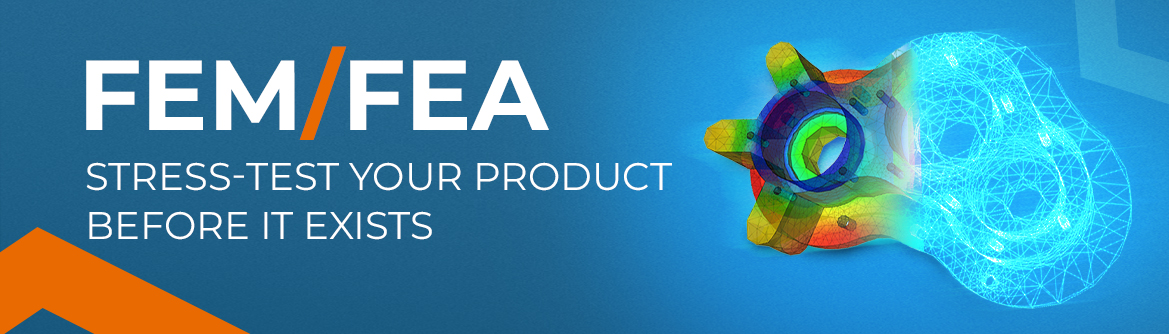
Finite Element Analysis – FEM or FEA – is the simulation method that allows structural and thermal behaviour to be evaluated on a 3D model before any physical part is manufactured. It works by dividing the geometry into thousands of small elements and calculating how each one responds to applied loads, pressure, vibration, or temperature change. The results show where stress concentrates, where deflection exceeds acceptable limits, where fatigue risk is highest, and where heat distribution creates problems that would not be visible in a static structural analysis.
The Two Things FEM/FEA Actually Shows
Most engineers think about FEM/FEA primarily as a tool for identifying failure risk – finding the locations where a design is likely to break, deform excessively, or behave in ways that the application cannot tolerate. That application is valid and important. But it represents only one direction of the information that simulation provides.
The other direction is equally commercially relevant: FEM/FEA also shows where a design carries more material than it actually needs. Over-engineered components are common, particularly in early design iterations where conservative assumptions are made to ensure the design works before the loading conditions have been fully characterised. Those conservative assumptions result in components that are heavier, more expensive to machine, and more expensive to produce than they need to be.
The numbers compound. A component that is 15% heavier than necessary contributes that excess weight and material cost to every assembly it goes into and every unit that comes off the production line. Across a production run of any meaningful volume, the difference between a design that has been properly analysed and one that hasn’t is a significant and entirely avoidable cost. FEM/FEA run at the design stage identifies both where material needs to be added and where it can be removed – which is why it functions as a design tool rather than just a verification tool when it is used correctly.
Why Timing Is Everything
The value of finite element analysis is almost entirely dependent on when in the development process it runs. This is a point that is frequently misunderstood in practice, often because simulation is positioned as a final verification step rather than a design input – something that confirms the design is acceptable before it is released, rather than something that shapes the design while it can still be changed.
When FEM/FEA is run as a final sign-off exercise on a frozen design, it can confirm whether the design meets requirements. If it does, the analysis adds some documentation value. If it doesn’t, the project has a problem: the geometry cannot be changed without restarting processes that have already been completed, and the options for addressing the identified weakness are limited to modifications that don’t disrupt the frozen design. In practice, this often means the failure mode is accepted, mitigated through conservative safety factors, or addressed through a more expensive downstream fix.
When FEM/FEA is run during active design development – before the geometry is finalised, while the design team is still making decisions about wall thickness, fillet radii, cross-section profiles, and material selection – the results directly influence those decisions. A stress concentration identified at this stage leads to a geometry change that costs nothing to implement. The same stress concentration identified after the design is frozen can cost a significant amount to address, and sometimes cannot be fully addressed at all without a fundamental redesign.
What the Analysis Actually Covers
The most common application of FEM/FEA in mechanical engineering is static structural analysis – evaluating how a component or assembly responds to applied loads under steady-state conditions. This covers the majority of structural design questions: will this bracket deflect excessively under the specified load, will this weld joint carry the required force, will this housing maintain its geometry under the clamping forces applied during assembly.
Beyond static structural analysis, FEM/FEA is also applied to modal analysis – identifying the natural frequencies at which a structure will resonate and the mode shapes associated with each frequency. This is relevant for any component that operates in an environment with vibration, which in industrial machinery is essentially everything. A natural frequency that falls within the operating frequency range of the machine creates a resonance condition that can cause fatigue failure even when the static loads are well within the design limits.
Thermal analysis – evaluating how temperature distributes through a component or assembly and what thermal stresses result from differential expansion – is a third major application area. In components that cycle between temperatures, or that operate with significant thermal gradients across their geometry, thermal stress can be the dominant load case even when the mechanical loading is straightforward. Combined thermo-mechanical analysis, which evaluates the interaction between thermal and mechanical loads simultaneously, is required when both are significant.
Your components operate under mechanical or thermal load?
We run FEM/FEA as part of the design process – early enough to actually influence the geometry, not just confirm what’s already been decided.
Talk to an engineer
How GFE Solutions Approaches FEM/FEA Work
At GFE Solutions, FEM/FEA is run as part of the design process – not as a final sign-off exercise. The practical difference is that our engineers are working with designs that can still be changed, which means the analysis results are actually useful rather than informative. When the simulation identifies a stress concentration or a deflection that exceeds the acceptable limit, the response is a geometry change, not a documentation note.
Our FEM/FEA work covers static structural analysis, modal analysis, thermal analysis, and combined thermo-mechanical cases. We work from 3D models provided by the client or developed as part of a broader design engagement, and we deliver results in a form that is directly usable by the design team – not just simulation outputs, but interpreted results with clear recommendations for design modifications where they are needed.
The work integrates naturally with our broader CAD and design engineering services. For projects where we are involved in both the geometry development and the structural analysis, the feedback loop between design and simulation is short and direct. For projects where we are brought in specifically for the analysis, we work from the client’s existing geometry and deliver results and recommendations that the client’s team can act on immediately.