A Number That Explains the Engagement
24 on-site visits to Germany over seven years. That number says more about how this engagement actually works than any service description could. It is not the output of a project that was scoped, delivered, and closed. It is the result of an ongoing technical relationship that has grown in scope each year because the work has consistently required it.
The client manufactures experimental synthetic fiber production lines – highly specialised machines where mechanical design, electrical systems, and fluid dynamics are all tightly interdependent. These are not standard industrial systems with well-understood behaviour and established control architectures. They are research-oriented production machines where the design is being developed, tested, and refined continuously, and where the control logic has to keep pace with that process.
Why a Conventional Approach Wouldn’t Have Worked
On equipment of this kind, the standard model for PLC programming engagement – where a control engineer receives a functional specification, develops the logic off-site, and joins the project at commissioning to make it work – is not viable. The functional specification cannot be frozen early enough to make that model work, because the machine behaviour that the specification needs to describe is still being discovered during development.
The control logic on these machines can’t be developed from a static document. It has to evolve in parallel with the mechanical design, respond to decisions being made in real time by the engineering team, and ultimately reflect the actual behaviour of the physical machine – not a theoretical model of it. That requires the control engineer to be present when those decisions are being made, not downstream of them.
It also requires a level of familiarity with the specific equipment that cannot be built quickly. Understanding how a particular machine behaves under different operating conditions, where the critical sensitivities are, which interlocks are genuinely safety-critical and which are operational protections – this knowledge accumulates over time through direct exposure to the system. It cannot be transferred efficiently through documentation, and it cannot be acquired during a commissioning visit.
How the Engagement Is Structured
Our engineer joined the core project team from the beginning of the engagement – not as an external consultant brought in at a specific project phase, but as a permanent member of the team, working alongside the lead engineer and design engineers throughout every project. The distinction matters. An external consultant brought in at commissioning is solving problems in a system they didn’t build. An engineer who has been part of the team from the start understands why every decision was made and can contribute to new decisions with that full context available.
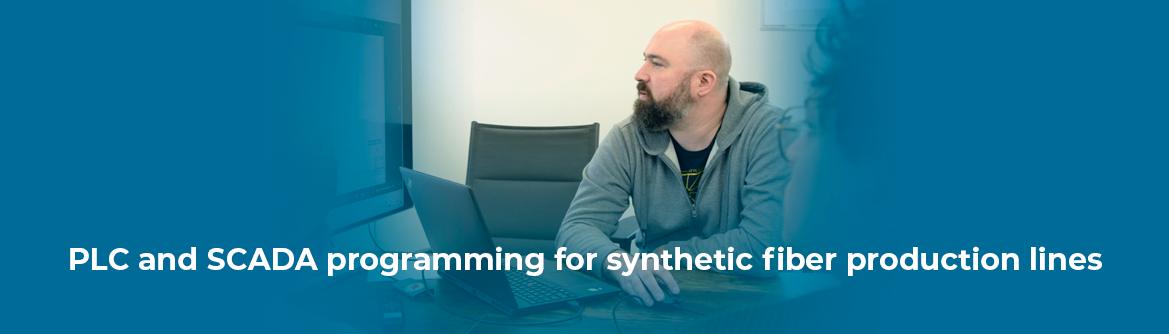
The work is developed in Siemens TIA Portal with SCADA integration. The scope covers the full control logic for each new machine variant, including operating sequences, safety functions, process monitoring, and the SCADA interface that allows the client’s research engineers to interact with the system during production runs. Each new machine in the program builds on the architecture established in previous ones, with modifications and extensions that reflect the evolving understanding of the process.
Between on-site visits, the engagement continues remotely. New requirements are discussed and specified, logic is developed and reviewed, and issues that emerge during client testing are diagnosed and resolved without requiring travel. The on-site visits happen when the work requires physical presence – during mechanical assembly integration, commissioning, and the testing phases where the control logic is being validated against the real machine behaviour.
What Seven Years of Continuous Engagement Produces
The engagement has been running since July 2019 and the scope has grown steadily. This is not unusual in long-term technical partnerships of this kind. As the relationship develops and the external engineer demonstrates consistent reliability, more of the control engineering scope is allocated to that person. The client’s internal team can rely on the external engineer’s knowledge of the system without having to maintain and transfer that knowledge themselves each time a new project begins.
The efficiency gains compound over time. The first project in an engagement like this carries the highest overhead – learning the client’s tools, standards, and working methods, building familiarity with the equipment, establishing the communication patterns that make remote collaboration work effectively. By the seventh year, that overhead has been fully amortised across every subsequent project, and the engineer working on a new machine variant is working with seven years of accumulated knowledge of how that client’s machines are built and controlled.
There is also a quality dimension that is harder to quantify but equally real. An engineer who has seen a specific class of machine go through development, commissioning, and field operation multiple times has a qualitatively different perspective on control logic design than one who has not. They have seen which interlocks prove their value and which ones create nuisance trips. They have seen how operators actually interact with the SCADA interface under production conditions. That experience shapes the logic they write in ways that specification documents cannot capture.
Working on a machine where the control logic needs to evolve with the design?
We integrate directly into your engineering team from the start – not at commissioning. Let’s talk about what your project needs.
Talk to an engineer
What This Model Requires From Both Sides
A long-term technical engagement of this kind does not happen automatically. It requires a client who is willing to invest in the integration phase – to allow an external engineer genuine access to the project, to include them in the discussions where decisions are actually being made, and to give them the time to build the familiarity with the system that makes them genuinely useful. That investment pays back clearly over time, but it requires a level of trust that has to be earned and maintained.
It also requires the external engineer to treat the client’s project with the same level of commitment and ownership that an internal team member would bring. Showing up at commissioning and solving the problems in front of you is one thing. Being present throughout the development process, raising concerns early, and taking responsibility for the quality of the control logic through the full lifecycle of the machine is something different. That level of engagement is what makes the difference between an external resource and a genuine engineering partner.
The arrangement that has been running since 2019 works because both conditions have been met. Some things only happen when you stay long enough – and are willing to do the work that staying requires.